
Interview Scott Metcalfe
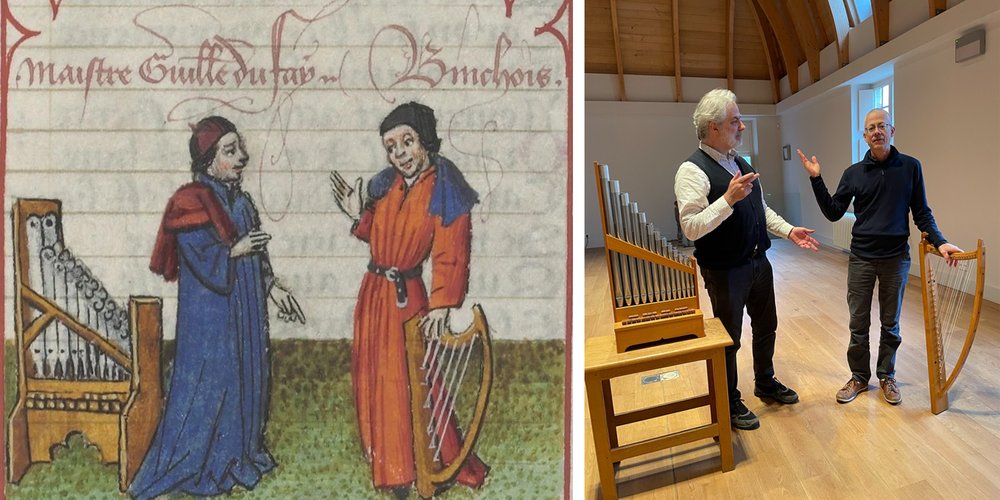
© Paris, National Library of France, Manuscripts Department, fr. 12476, f. 98r (left)
On 11 December, researcher and musician Scott Metcalfe will conclude his residency at the Alamire Foundation and return to the United States. On the occasion of his departure, we asked him a few questions about his time in the Low Countries, his work on a new critical edition of Binchois’ chansons, and the spontaneous idea to recreate the famous illustration of Du Fay and Binchois in 'Le champion des dames'.
What did you work on during your residency at the Alamire Foundation?
"The project is to make a new critical edition of the songs of Binchois. There are about sixty of them. I've done a lot of work on it beforehand, and there's more to do, of course. But what I mostly did here was the critical combing through each source, making sure that we have an exact and completely accurate transcription of every individual source. There are about 160 readings in total, from all sorts of manuscripts. The next step is to collate all the versions of the same song, whether there is one, or sometimes even twelve. Usually the average is just a small number, between two and four. Then you try to establish a correct text. That means comparing the different versions and picking the best reading. The normal process here is to pick a best source and basically do a single source edition, but an emended single source edition. So, it's not hands off and saying: “We just print exactly what it says in the source even though we can see that there's a contrapuntal error here.” You try to fix any obvious errors, and then you begin to see if you can fix the less obvious errors or things that look wrong, but a little harder to tell if they are. Binchois is well known as a composer who accepts a fairly high amount of dissonance in ways that other famous composers of the period don't. Each composer has his own individual style, a kind of stylistic signature. Part of this process has been getting to know what Binchois’ style is down to this granular level. Will he do this kind of dissonance in this situation, or do I feel like he doesn't do this in works that are definitely his?
That's the jist of it down to the nuts and bolts, and the same thing applies to all the French texts, where we encounter the same sort of problems. On the whole, for Binchois, we're pretty well served concerning the texts–better than for composers of a later generation. Take for example Busnoys: a lot of his songs have no text, or a very partial text. Sometimes they were copied by Italian scribes who clearly didn't really know French—a real headache to deal with. We're much better off with Binchois. I think there are only four songs out of sixty or so that have incomplete texts.
I've been working somewhat monk-like here at the House of Polyphony and plowing through things as efficiently as possible. I expect by the time I leave that I will have a draft of an edition of every song, including the complete critical notes, where needed a draft of the restoration with the text underlayed for performance, and suggestions for chromatic inflections, cadences, and what we call ‘musica ficta’ now. So that will be done or largely done. What will remain is tidying up some of the more problematic songs, and preparing the introductory matter. Sean Gallagher [musicologist affiliated with the New England Conservatory of Music, US, who was visiting for a few days] and I are working together on this. He's going to write this sort of global introduction, while I'll be talking about a lot of performance practice questions—scoring, pitch, pronunciation, text underlay…"
What made you choose the Alamire Foundation for your research?
"My association with the Alamire Foundation goes back almost ten years. I was involved with the research on the Leuven Chansonnier fairly early on. In 2017, I attended the conference in New York, and after that I worked on critical editions of the unique songs, both their musical and poetic texts. I've actually known Bart [Demuyt] for at least thirty years. In fact, we were in a concert together at the very first edition of Laus Polyphoniae. He was singing with Currende and I was playing Renaissance viola with The King’s Noyse. That was in the Lassus-year. I've published a couple articles by now in the Journal of the Alamire Foundation. I've also known Stratton [Bull] for a really long time and I've visited the House of Polyphony again in 2018 for a workshop around the unique songs of the Leuven Chansonnier, sitting around a table while talking and singing, trying to tease out questions about problematic readings. So it was very logical for me to write to Bart and David [Burn] and propose this residency.
And of course Binchois is from here, right? He was born in Mons, not far; his family was from Binche, also very close. He was a member of the Burgundian court from the 1420s until he retired to Soignies and was associated with it after his retirement as well. So he lived and worked in this area. His music is also exactly within the target repertoire of the Alamire Foundation. So it’s a perfect fit. It's been wonderful for me to be here, to travel a bit within the old Burgundian territories and just to steep myself in the atmosphere, go to the buildings, see some of the art where it's from. That's definitely been advantageous, just in a sort of contextual understanding of where the music comes from and the milieu that it was composed for and in.
Aside from that, the Park Abbey, where the Foundation is located, is just an incredibly congenial place to work. Everyone has been so welcoming. Resources are perfect and I have a great space to work in, so I've been able to get a lot of work done. On some moments I could listen to Cappella Pratensis [ensemble in residence] rehearsing right next door doing Ockeghem’s lament for Binchois [Mort tu as navré de ton dart] and Ockeghem’s Requiem and other music that's from composers very much tied to this place and time. It’s the repertoire that I am occupied with, so that's been inspiring."
Did you travel in Belgium for your research work?
"I did. I just took this sort of road trip to visit Binche and Saint-Ghislain, which is west of Mons and the place where Ockeghem was born, which I actually couldn't miss. I went through Soignies on the way back, where Binchois retired. He was a member of the Collegiate Church of Saint-Vincent, which is also where Johannes Regis worked. In Soignies, there were a lot of other musicians. It was a really important musical place for a while. Certainly in Regis's era and for generations after, because the city gets discussed in sixteenth century accounts of music in the Low Countries as being one of the most important centers of good singing—in the same breath as Cambrai. Soignies is less known now, but at the time the city was very important. Guillaume de Malbecque was there, another contemporary of Du Fay, and who was Binchois’ executor. So, wonderful to be there as well.
I also got to Ghent, and spent a lot of time with the Ghent altarpiece by Van Eyck, which Binchois almost certainly saw. He joined the court in the mid-late 1420s, and I think it's inevitable that they were in Ghent at some point, possibly to sing, and he would have seen it then. He was probably in his early 30s around that time. Next week I'm going on holiday with my family in London, where I’m planning to see a portrait of Van Eyck from 1433 and The Arnolfini Wedding (1434) in the National Gallery. There is also another picture called Timotheus (1432). It's been proposed that the man in this portrait was Binchois, but there's really no evidence for it, it's a notion. All three of those paintings are from the 1430s, I believe, so right in the middle of Binchois’ life."
Could you tell us some more about the ‘tableau vivant’ you recreated with Sean Gallagher?
"When Sean was here, we were walking through the Obrecht-room at the House of Polyphony, and there’s an organetto from the Foundation's instrument collection. I think it just prompted Sean to remember there's this picture of Du Fay and Binchois in Le champion des dames, from 1442. It’s a super famous picture of the two composers. They're identified there as ‘Maître Guillaume Dufay’, and then the guy on the right of the harp is Binchois. Sean saw the organetto and I said: “There's a harp just like this in the instrument room next door.” We got those out and recreated the picture sort of informally." (smiles)