
Residencies

Plainchant and polyphony come to life when played by musical ensembles who rehearse, experiment and give concerts at the House of Polyphony. These ensembles also offer practice-based insights. The ensemble in residence Cappella Pratensis—with which a long-term cooperation agreement has been concluded—is given practical support for its activities, whereas Park Collegium’s sessions are remunerated, so that professional musicians are enabled to spend time on practice-oriented research. Renowned international ensembles are offered short-term residencies on a project basis.
CAPPELLA PRATENSIS

Cappella Pratensis specializes in the music of Josquin Desprez (= Josqinus Pratensis) and other polyphonic composers of the fifteenth and sixteenth centuries. The ensemble performs its own programs and original interpretations, which are based on academic research. As was customary in the Renaissance, the singers of Cappella Pratensis usually stand around a central music stand, singing from facsimiles of original choirbooks. This creates a unique perspective on the repertoire. The ensemble, founded in 1987, is now under the artistic direction of singer and conductor Tim Braithwaite.
Besides the in-house ensemble ParkCollegium, the House of Polyphony also accommodates ensembles in residence. As well as giving high-quality performances, these ensembles are expected to make an active contribution to the Alamire Foundation’s projects. Where ParkCollegium is focused to a great extent on young singers, the ensembles in residence can rely on specialized expertise in historically informed performance practice. Thus they have an important role in the practice-oriented research to which the Alamire Foundation aspires, which is reinforced by interaction between them.
PARKCOLLEGIUM
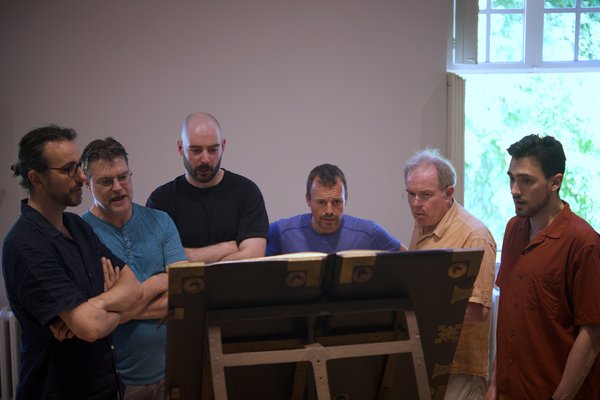
ParkCollegium is a collective of internationally renowned musicians who come together on a project basis at the House of Polyphony for several days each year to engage in the practice-based research of the Alamire Foundation. Coordinated by staff member Stratton Bull, Jonty Coy (AU), Andrea Gavagnin (IT), Marc Mauillon (FR), Julian Podger (UK), and Vojtěch Semerád (CZ) work around specific themes. During intensive laboratory sessions, they are given the opportunity to immerse themselves in both familiar and lesser-known repertoire, to make new discoveries, to explore freely, and to test academic research against musical practice.
The ensemble's work always begins with the original source material and notation, consulted either in facsimile or through the projection of digitized images from the Integrated Database for Early Music (IDEM). The insights gained during these sessions are subsequently carried into the musicians' own projects, ensuring that new knowledge generated in Leuven is disseminated and incorporated into historically informed performance practice around the world.