
Journal of the Alamire Foundation Vol. 17/2
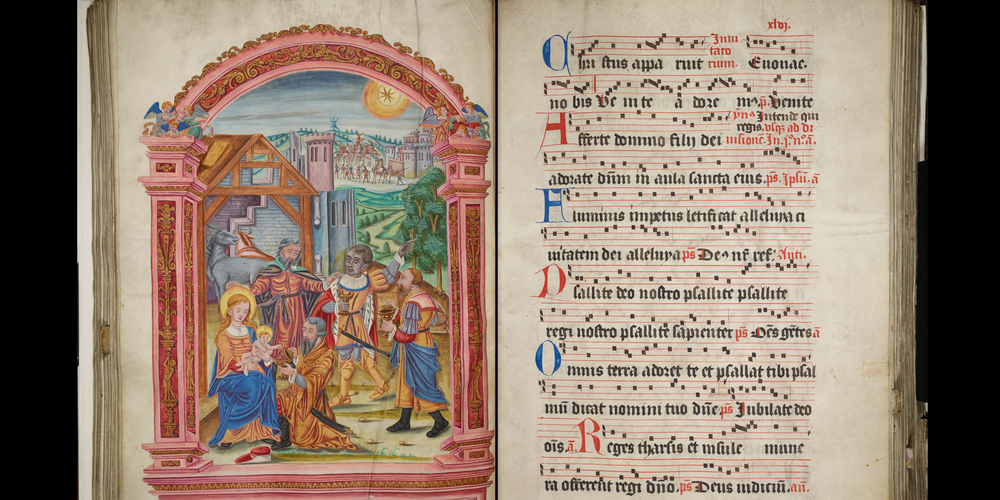
© Halifax, Saint Mary’s University, Patrick Power Library, ms. M2149.L4, ff. [45bis]v - 46r / Alamire Digital Lab
The city of Halifax in Canada may not be the first place where one would expect to encounter a sixteenth-century manuscript from the Low Countries. Yet the Patrick Power Library at Saint Mary's University is proud to hold just such a remarkable treasure in its collection: the 'Salzinnes Antiphonal'.
This lavishly illuminated manuscript from the Cistercian Abbey of Salzinnes (near Namur) ended up in France after the destruction and plundering of the monastery in 1795. In the mid-nineteenth century, the Archbishop of Halifax acquired the codex in France and brought it with him across the Atlantic. Eventually, in the 1970s, the manuscript was donated to the Patrick Power Library, where it gathered dust for many years until it was ‘rediscovered’ by chance in 1998 by Judy Dietz, at the time a curator at the Nova Scotia Art Gallery. Under her guidance the source subsequently underwent intensive study and analysis, the results of which were exhibited in Canada in 2018. Five years later, the manuscript returned home temporarily for a second exhibition.
As the first of two issues devoted to the Salzinnes Antiphonal, the latest issue of the Journal of the Alamire Foundation focuses in three articles on manuscripts in Canadian collections and on the ways in which the Salzinnes codex has stimulated the development of digital tools within research on plainchant. In addition, two stand-alone papers address, respectively, Ludwig Senfl's Missa dominicalis: L'homme armé, and the growing importance of digitization in the study of medieval and early modern music sources.
As always, the digital edition of the Journal of the Alamire Foundation is available in open access on the Brepols website. Interested in seeing images of the Salzinnes Antiphonal? The mobile Alamire Digital Lab travelled to Halifax to digitize the manuscript. You can view the images with their descriptions on the Integrated Database for Early Music.