
How can centuries-old manuscripts and printed music sources be made accessible through modern technology?
Manuscripts and printed music sources from the Middle Ages and the Renaissance rarely reach us in pristine condition. Time invariably leaves its mark, whether through human intervention or the forces of nature. As a result, these often invaluable sources must be handled with great care and caution when consulted in the libraries that preserve them.
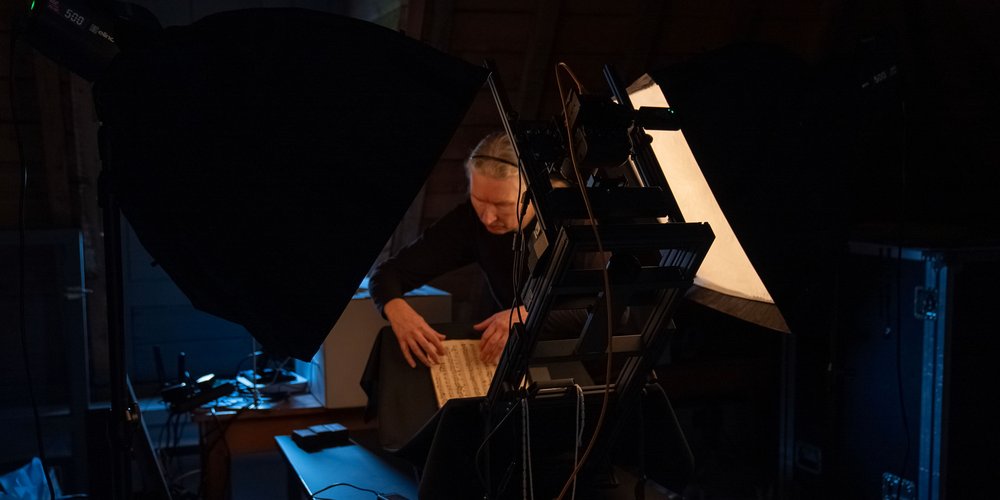
For many years, the Alamire Foundation has offered a solution to this challenge through the Alamire Digital Lab (ADL), a mobile digitization unit. By creating high-resolution digital images of manuscripts and printed books and making them available through the Integrated Database for Early Music, we provide broad access to hundreds of music sources dating from the eighth to the nineteenth century. Or, put simply, they can be consulted from the comfort of your own armchair.
The digitization team is active both internationally and within Belgium. Just a few weeks ago, for example, the first of the six Leiden Choirbooks was digitized in Leiden, the Netherlands. Closer to home, the ADL will travel to Ghent in December to photograph the ‘Tsgrooten’ Antiphonary, a sixteenth-century manuscript containing plainchant, using Multispectral Imaging (MSI). This advanced, non-invasive imaging technology reveals layers and details that remain invisible to the naked eye, offering new insights into both the history of the source itself and the context in which it was used. In the video above, staff member Lynda Sayce explains how MSI works and why it is such an important tool.
A perfect example of interdisciplinary research at the crossroads of computer science, source studies, and cultural heritage conservation: on Science Day in Flanders (15 November 2026), it is hard to imagine a more fitting illustration of what research can achieve.