
The Boundary Element Method as a State-Space Realization Problem
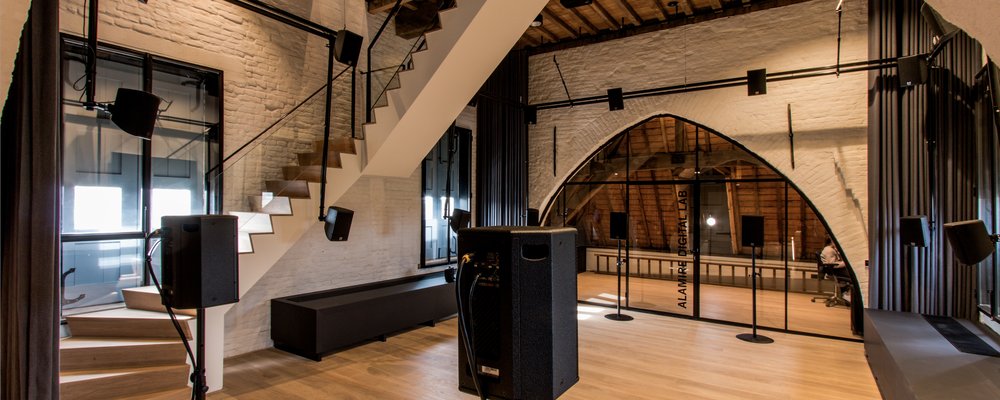
Alamire Sound Lab, Library of Voices
The boundary element method (BEM) is a numerical method for modeling wave propagation problems. In this proposal, we address two particular problems related to the BEM, both of which are impeding the application of the BEM to our area of interest, that is, sound propagation in enclosures, i.e., room acoustics. Firstly, the BEM is most often applied in the frequency domain, representing a steady-state solution to a wave propagation problem. However, in order to represent wave fields generated by spatiotemporally nonstationary sources, a time-domain approach is needed. Time-domain BEM has only been scarcely considered as it is prone to instability problems. Secondly, the accuracy of the BEM solution is highly dependent on an accurate formulation of the boundary conditions, hence requiring a detailed characterization of the material properties of the enclosure, which is often infeasible. Both problems will be addressed by exploiting a formulation of the BEM that has remained underexplored in literature. The time-domain boundary integral equation from which the BEM is derived, can be rewritten into a continuous-time, discrete-space state-space model. This representation will firstly allow to understand how stability can be preserved when moving from continuous to discrete time. Secondly, it naturally leads to the formulation of a state-space realization problem that yields the perspective to estimate the boundary conditions from impulse response measurements.